
LuminoDx Inc

BIODISTRIBUTION


Do you need molecular analysis of samples from your biodistribution study?

LuminoDx is CLIA/CAP validated and GLP compliant.

LuminoDx will design your molecular assay to your specifications, analytically validate it, and analyze the samples from your study.

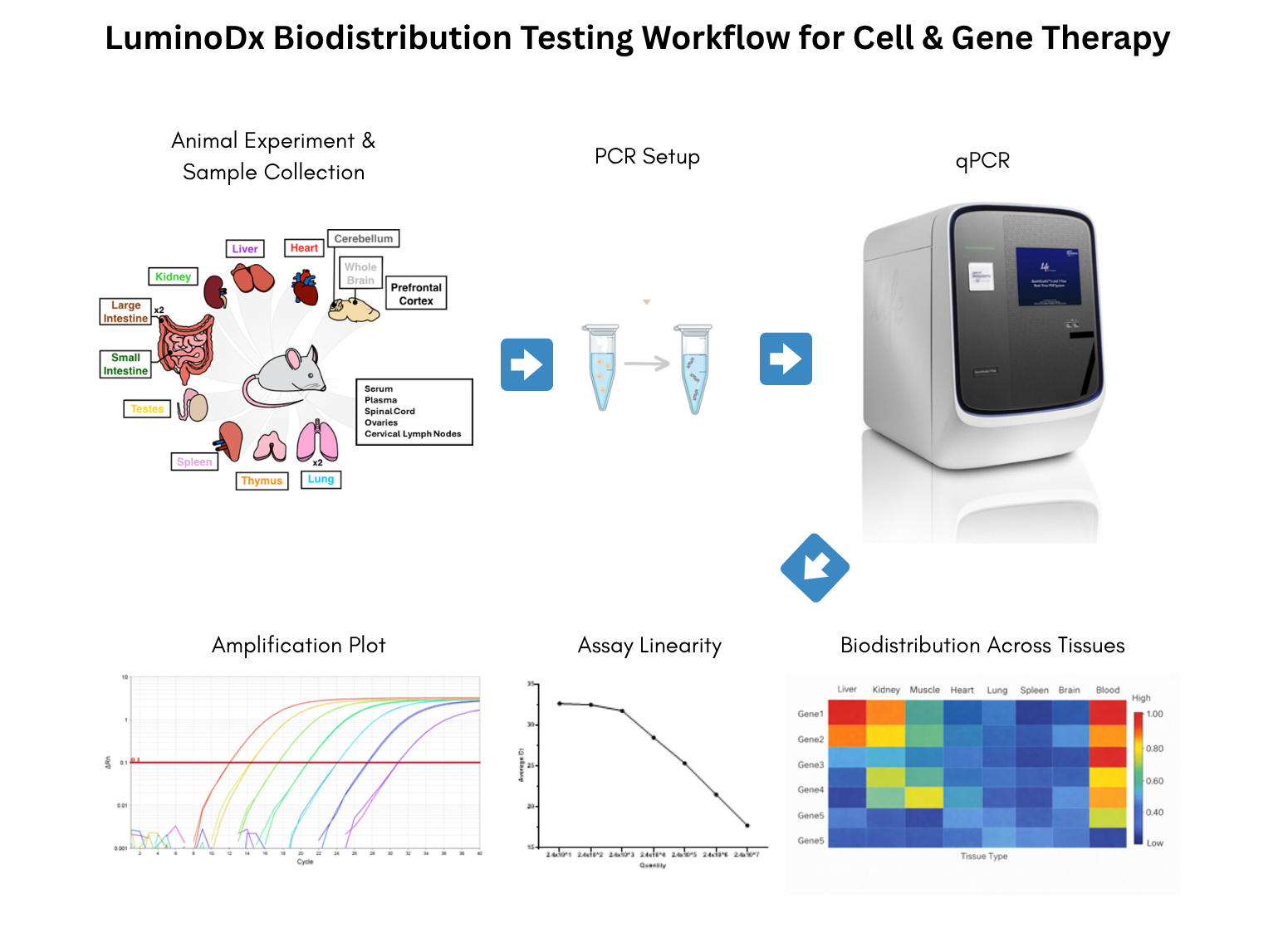
The steps LuminoDx will take:

Assay Development and Optimization

Nucleic acid extraction will be carried out with analytically validated methods from different tissue types (e.g., liver, spleen, brain) to ensure high yield, purity, and minimal PCR inhibitors.

Assay Design: Primers and Probes will be selected specific to the test article (e.g., the target’s DNA sequence) to prevent cross-reactivity with host DNA or other related sequences.

Standard Curve: A calibration curve with known concentrations of the target nucleic acid will be formulated (e.g., a plasmid) in a background of host DNA. This curve will be used to quantify the test article in unknown study samples.

Analytical Validation

Molecular assays used in Good Laboratory Practice (GLP) biodistribution studies undergo rigorous analytical validation.

The following key parameters will be assessed during the formal analytical validation:

  • Accuracy: Measures how close the measured concentration is to the true or nominal concentration. This is evaluated by spiking blank matrix samples with known amounts of the test article and assessing the percent recovery.
  • Precision: Assesses the reproducibility of the assay. This includes:
  • Intra-assay precision (within-run variability): Analyzing replicate samples within a single run.
  • Inter-assay precision (between-run variability): Analyzing samples across multiple runs, different days, or by different analysts.
  • Linearity and Reportable Range: Determines the range of concentrations over which the assay is linear and accurate. This establishes the Lower Limit of Quantification (LLOQ), the lowest concentration that can be measured with acceptable accuracy and precision, and the Upper Limit of Quantification (ULOQ).
  • Specificity and Selectivity: Ensures the assay measures only the target analyte and is not affected by interfering substances in the biological matrix or other related sequences. This is confirmed by testing blank matrices and matrices from control animals.
  • Sensitivity: Defines the Limit of Detection (LOD), the lowest concentration that can be reliably detected, but not necessarily quantified.
  • Stability: Evaluates the stability of the analyte in the biological matrix under different storage conditions, including freeze/thaw cycles, short-term benchtop stability, and long-term storage stability. This ensures the integrity of study samples over time.
  • Robustness: Assesses the assay’s ability to remain unaffected by minor changes in procedural parameters, such as a different reagent lot or a slight change in thermal cycling conditions.

Documentation and GLP Compliance

All steps of the validation process will be thoroughly documented to meet GLP principles. This includes:

  • A detailed validation plan approved before the work begins.
  • Standard Operating Procedures (SOPs) for all analytical procedures.
  • Comprehensive raw data for all validation runs.
  • A validation report summarizing the results for each parameter, with clear acceptance criteria defined in the validation plan.

Once validated, the molecular assay will be considered “fit for purpose” and can be used to analyze study samples from the biodistribution study, with ongoing quality control checks included in each run.

For Quality, expedient results for your submissions please consider LuminoDx!
Start typing to see posts you are looking for.
Shop
Wishlist
0 items Cart
My account